EducationHouse@UNGA80 Longtable Discussion
23 September 2025 - New York, USA
~80 participants | Global
By: The Education House Team
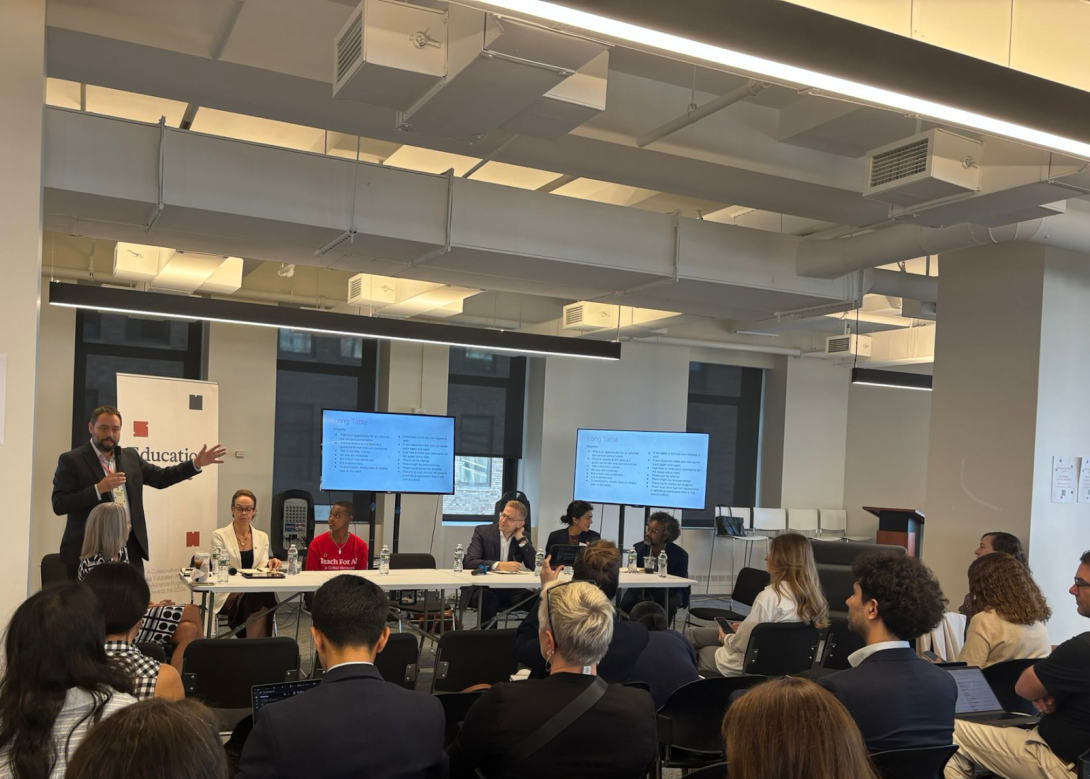
To truly equip students to shape a better picture of our world, we must first dismantle the outdated notion that education is a slow-motion preparation for a distant adulthood. Instead, we must treat the classroom as a living laboratory for the present. This starts with how we gather: the Long Table format.
The Long Table: Equalizing the Architecture of Dialogue
The Long Table is not a traditional panel or a passive roundtable; it is a "performance of a dinner party" where conversation is the only course. Developed by artist Lois Weaver and inspired by the feminist film Antonia’s Line, this non-hierarchical format functions as a public forum designed to break down institutional barriers. In a Long Table session, there are no fixed "experts" at a podium. Instead, a core group sets the table with initial "food for thought," but anyone in the room—student, teacher, or activist—can pull up an empty chair to join the conversation at any time.
The etiquette of the format is simple: you must be seated at the table to speak, and you must leave the table when you are finished to make room for others. This "flow" ensures that the domestic realm of a dinner party becomes a stage for public thought, equalizing voices and ensuring that those who are often marginalized have an immediate seat at the center of the debate. It is a democracy of ideas where scribbling on the paper tablecloth is encouraged, and where the goal is not a neat conclusion, but a continuous, shared making of knowledge.
Expanding the Definition of "Foundational"
When we bring this inclusive energy to education, we move beyond the silos of literacy and numeracy to embrace a curriculum rooted in a Foundational Love of Nature. This is not a sentimental addition, but a survival imperative; it recognizes that ecological stewardship and social awareness are the baseline skills required to ensure there is a world left to inherit. By expanding what is foundational, we elevate agency and self-awareness to the same status as traditional academics, viewing them as the core competencies required for building wellbeing and making change.
From Gatekeeping to Collaborative Autonomy
This transformation requires a radical pivot in the power dynamics between generations. For too long, the adult world has operated as a gatekeeper, inadvertently constraining student potential through a lack of trust. To unlock the agency necessary for systemic change, we must transition from a model of control to one of collaborative autonomy. By integrating students into knowledge-sharing communities—modeled after the open, collective architecture of Wikipedia—we allow them to move from passive recipients of information to active curators of the greater good. In this ecosystem, the freedom to make and learn from mistakes is not a failure of the system, but a primary feature of authentic growth.
Revaluing the Force Multipliers
At the center of this shift stands the teacher, reimagined as the ultimate "force multiplier." In this new light, educators are not merely conveyors of a syllabus; they are activists, mentors, and the primary architects of a student’s mental and emotional safety. Revaluing this profession is the single most effective lever for scaling change. However, this leadership cannot exist in a vacuum. We must be honest about the material realities that ground these aspirations. Meeting basic needs—most notably through universal school meals—is a non-negotiable prerequisite. We cannot ask a child to master the complexities of agency or planetary empathy if their immediate reality is defined by hunger.
Ultimately, this is a call to redesign the very machinery of education—from the assessments we use to the values we prioritize. By measuring what we truly value, such as resilience and connectedness, rather than what is merely easy to test, we signal to students that their worth is not tied to a score, but to their capacity for human flourishing. We have borrowed this Earth from the next generation; our responsibility is to return it to them alongside an education system that values their curiosity over our own institutional habits, ensuring they have the tools to think larger and more inclusively than we ever did.