Kids Education Revolution
6-8 February 2026 - Mumbai, India
200 engaged | Mumbai, India
By: The Global Institute for Shaping a Better Future Team
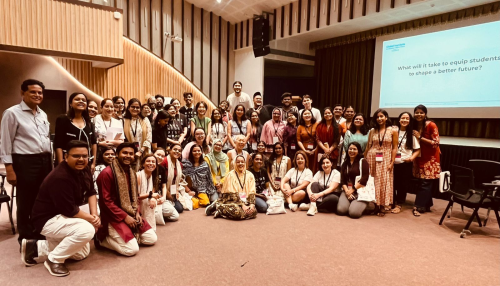
A strong throughline across the conversation was the importance of creating spaces for people to come together to learn from one another — particularly across countries and contexts. Participants reflected that while there is no shortage of promising ideas and innovations, what is often missing is the connective tissue between them. Community, especially when it is informal and sustained over time, plays a critical role in enabling these ideas to travel, evolve, and take root in different settings. These networks of trust and shared inquiry often become the quiet engine behind progress, allowing educators and leaders to test, adapt, and build on each other’s work rather than operating in isolation.
Within these spaces, participants found particular value in surfacing and exchanging practical examples from classrooms and schools. Rather than abstract theories, it was the grounded, lived experiences of educators that resonated most strongly — how they are rethinking pedagogy, designing learning environments, and making day-to-day decisions to support students more holistically. These examples helped to make the idea of “holistic development” more tangible, showing the diverse ways it can be interpreted and enacted across contexts.
One recurring insight was the power of “doing less” as an intentional pedagogical choice. Several participants shared that stepping back as educators — creating space rather than filling it — can enable students to take greater ownership of their learning. This shift allows students to ask their own questions, pursue their own interests, and develop a stronger sense of agency. Importantly, this is not about lowering expectations, but about rebalancing the role of the teacher from director to facilitator, and trusting students as active contributors to their own learning journeys.
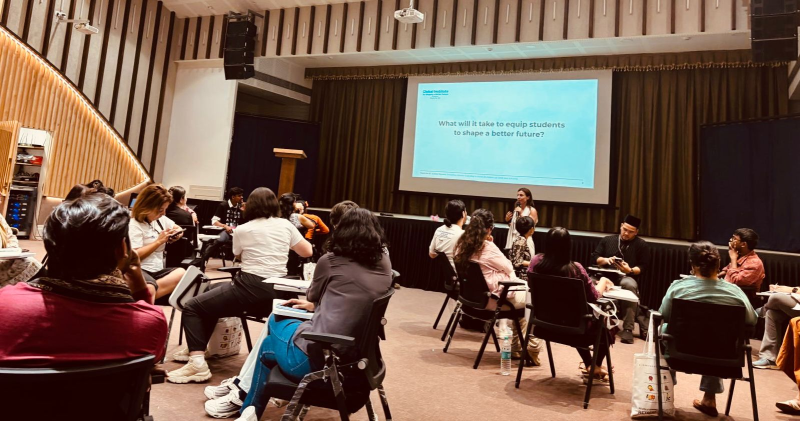
At the heart of many of these practices is a deeper shift in classroom power dynamics. Participants emphasised that supporting holistic student development requires moving away from traditional hierarchies where the teacher holds authority over knowledge and decision-making. Instead, classrooms need to become spaces where power is more distributed — where students feel psychologically safe, heard, and respected. This sense of safety is foundational; without it, students are unlikely to take risks, express themselves authentically, or step into leadership of their own learning. Shifting these dynamics is therefore not an add-on, but a prerequisite for enabling the kinds of outcomes participants are seeking.
Finally, there was a strong call to reorient how we define and measure success in education. Many participants reflected on the limitations of systems that prioritise grades and narrow academic outcomes, often at the expense of broader human development. There was a shared recognition that if we want young people to shape a better future, we need to value not only what they know, but who they are becoming — their mindsets, attitudes, sense of purpose, and belief in what is possible for themselves and their communities. This includes cultivating qualities such as curiosity, resilience, empathy, and agency, and recognising these as central, rather than peripheral, to education.
Taken together, these reflections point toward a broader shift: from education as the transmission of knowledge to education as the development of whole human beings, within communities of shared learning and collective leadership.