Better Future Conversations: What Will It Take to Reshape Education So We Can Reshape the World?

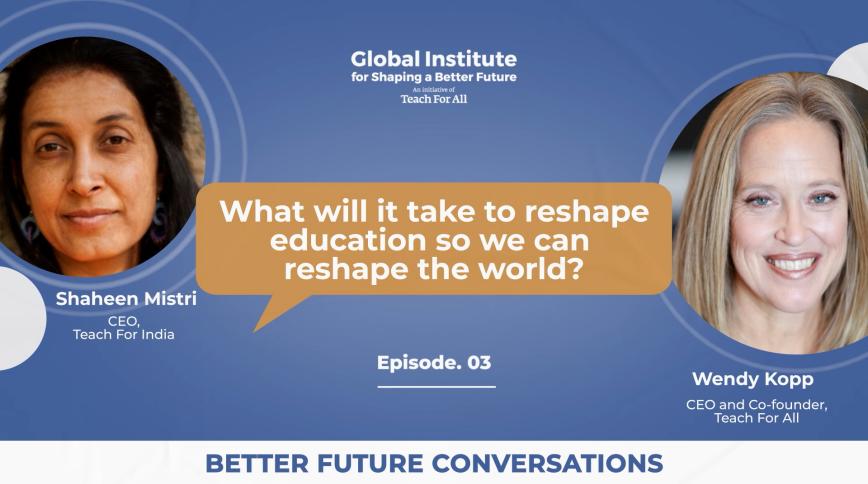
In the most recent episode of our Better Future Conversations, I talked with Shaheen Mistri, CEO and Founder of Teach For India, and her Grade 7 student, Durva. They invited all of us into a different way of thinking about education, one that centers love in how we teach, lead, and imagine a better future.
Shaheen and Durva offered a vision for reshaping education through practices grounded in relational bonds in the classroom and across the entire system and through acts of care that accumulate into profound shifts in who children become and the world they’ll help shape.
A Purpose of Education Rooted in Self, Other, and Nation
I began the conversation by asking Shaheen what she believes the purpose of education to be. She shared that it rests on three pillars—self, other, and nation. In her view, education must help children discover “truly who they are”; nurture their capacity to care for others, embrace difference, and listen to those around them; and instill the belief and capacity to make the world better and kinder. And importantly, it must help students understand they can begin contributing to a better world today, not twenty-five years from now.
Love as the organizing principle
Throughout our discussion, love was not presented as sentimentality. Instead, it emerged as the operating system of transformative learning, a way of being and a set of daily, observable practices embedded in everything from lesson planning to morning greetings.
As Durva explained, “Love is everywhere… even a painter painting has love behind it”. She sees it in music, in art, in her mother packing an extra snack and carrying her backpack so she wouldn’t struggle on the way to class.
Shaheen illustrated how this shows up in daily practices. Love shows up in the adult who greets a child with joy, listens without rushing, or says thank you with sincerity. For her, this is the work. These are the conditions under which even academic excellence becomes possible, because children step into their fullest potential only when they feel safe, seen, and valued.
What struck me most is that there is no playbook for leading with love. It shows up in countless micro-practices, improvised in real time. Durva listed some examples: “Say sorry when your mistake is there, say thank you, help anyone—even a stranger… just smiling, just saying good morning, just saying hi”.
These tiny gestures accumulate into habits of being. They shape how children see themselves and how they relate to others. They turn classrooms into ecosystems of belonging. And they model what it means to live with compassion.
Shaheen framed these micropractices as the most scalable part of deep educational work. Big solutions may appear efficient, but they can fail to touch the human core of the education experience. What truly multiplies, she suggests, are the small acts done with great intentionality. “We are here to plant the seeds with intentionality and with love… You don’t need to change the whole world. You just need to take small steps every day.”
Developing and sustaining ourselves
There is no algorithm or curriculum that can substitute for the human presence of an adult committed to deep care. And yet, precisely because there is no recipe, this work requires something demanding: self-work.
Shaheen was open about how much inner work it takes to consistently choose love in a world shaped by scarcity, fear, and overwhelm. She talked about the disciplines that sustain her: daily routines, grounding practices, surrounding herself with people who embody the qualities she wants to cultivate, and, perhaps most importantly, continuing to work directly with children.
And when teachers might worry this approach might add to their overwhelm, Shaheen offers an inversion: “This is the work that relieves the overwhelm. The work that brings joy”. Because leading with love does not require additional time or elaborate planning, it requires presence. It requires shifting from control to shared responsibility. It requires recognizing that classrooms become lighter when students share leadership, when they are encouraged to take initiative, when the “many-to-many” learning environment replaces the brittle weight of the teacher-centric model.
Shaheen argued, and Durva demonstrated, that when love is woven into the everyday fabric of the classroom, teaching becomes more joyful, not more burdensome. Leading with love is not “one more thing”; it’s the thing that makes the rest sustainable.
We cannot model what we have not practiced. If we want children to grow in compassion, forgiveness, courage, or interdependence, then we must be on that journey ourselves. As Shaheen puts it, “you cannot guide children toward love if you are not walking the path yourself.”
Scaling through depth, not breadth
One of the most ever-present tensions in education is the question of scale. When I asked Shaheen what it would take to scale this kind of education across India, or the world, her answer reframed the question entirely.
She has shifted away from thinking of scale as expanding programs or replicating models. Instead, she sees scale emerging organically when adults work deeply with children and trust what grows. She shared that this year at Teach For India, “70 of our students are today fellows”, a multiplier effect no strategic plan could have engineered.
Love is what multiplies. People doing small things with great love create the conditions for transformation. It is a countercultural vision in a world conditioned to search for rapid, standardized solutions.
A System Built on Relationships, Joy, and High Expectations
Asked what teachers should do to help students receive a transformative education, Durva answered: “Create a bond. Build a connection. Make room for children to express their feelings, their emotions, their struggles.”
She spoke of leading Love Circles herself, spreading what she has learned to younger students. Love Circles are spaces where students “learn love deeply” by paying attention to the world around them and the people in it. She also spoke of helping peers learn their lines during a performance rehearsal, and how children rise when adults step back and trust them. Her voice made it unmistakable that children are ready to lead if we are ready to partner.
If we want to change education, we can begin by strengthening the bonds between teachers and students. We can make learning joyful. We must create spaces where every child feels free to express themselves. We can allow classrooms to be places of color, song, imagination, and discovery. This partnership, grounded in connection, is what makes school not simply a site of instruction but a community for leadership development.
Ultimately, what Shaheen and Durva remind us is that education is, at its heart, a human endeavor. It relies on relationships more than technical resources, and also on the courage to love in systems that often incentivize anything but.
At the end of our conversation, Shaheen distilled the message to its essence: Bring love into the system. Move from fear to love. Re-center joy.
Thanks to Shaheen and Durva for showing us the path to the better future we imagine, and to sustaining and developing ourselves along the way.
Stay Connected
This conversation is part of Better Future Conversations, an ongoing space featuring thought leaders from all over the world who can advance our collective thinking.
We’d love to stay connected. Sign up to receive updates and join us live for the next episode.