Network on Education Quality Monitoring in the Asia-Pacific Annual Meeting
8-9 June 2025 - Bangkok, Thailand
~70 participants | Asia Pacific Region
By: Carolyn Lai, Global Institute for Shaping a Better Future
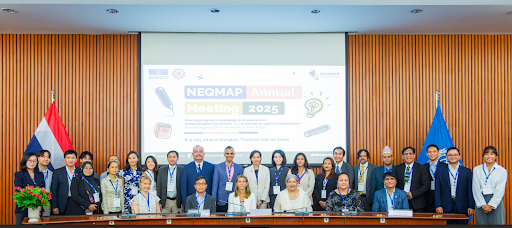
The 2025 Network on Education Quality Monitoring in the Asia-Pacific (NEQMAP) Annual Meeting in Bangkok provided a critical platform to examine how education systems must evolve when we fundamentally shift our purpose from merely transmitting knowledge to empowering students as agents of positive change. Our presentation on measurement and evaluation frameworks touched on some of the profound implications that extend far beyond assessment—touching the very core of how we conceptualize, deliver, and evaluate educational success.
Redefining Success: From Academic Achievement to Human Flourishing
The most immediate implication of purpose-driven education is a complete reconceptualization of what constitutes educational success. Traditional metrics, while important, capture only a fraction of the competencies students need to navigate and improve an increasingly complex world. When education aims to equip students to shape a better future, we must measure what we truly value: empathy that bridges divides, collaboration that solves collective challenges, and communication that builds understanding across differences.
The work through the Collaboration on Measuring Social-Emotional Learning in Africa (ComSELA)—a pilot project spearheaded by three Africa network partners: Teach For Kenya (TFK), Teach For Uganda (TFU), and Teach For Zimbabwe (TFZ),—demonstrates that this shift is not merely aspirational but practically achievable. By developing hybrid assessment approaches that combine student self-reports, group performance tasks, and observational rubrics, we've shown that holistic competencies can be meaningfully measured even in resource-constrained environments. This represents a fundamental departure from assessment systems that prioritize standardization over what is contextually-relevant for schools and systems.
Democratizing Educational Purpose Through Participatory Design
Perhaps the most transformative implication is the democratization of who gets to define educational purpose. When we center student voice and teacher leadership in shaping success metrics, we move from top-down mandates to bottom-up ownership. The ComSELA project's approach of using student visions to inform target outcomes and engaging teachers as action researchers represents a radical departure from traditional education governance.
This participatory approach has profound implications for educational equity. When students from under-resourced contexts in Kenya, Uganda, and Zimbabwe help define what success looks like, their lived experiences and aspirations become central to the educational framework rather than peripheral considerations. This shift challenges the historical pattern of educational standards being developed in resource-rich contexts and imposed elsewhere.
Innovation Through Constraint: Equity as a Design Principle
The practical challenges of implementing purpose-driven education in resource-constrained environments have yielded unexpected insights about equitable assessment design. By necessity, the team's tools had to work in classrooms with large student-teacher ratios and limited resources. This constraint became a catalyst for innovation, leading to assessment approaches that are more inclusive and authentic than many resource-intensive alternatives.
The combination of group-based tasks with individual scoring options exemplifies how equity considerations can drive methodological innovation. Rather than seeing resource constraints as barriers to quality assessment, the team discovered they could inspire more creative, contextually responsive solutions that better serve all students.
Building Global Learning Networks: From Isolation to Collaboration
The enthusiastic response from NEQMAP participants revealed another crucial implication: the hunger for collaborative learning networks around holistic student outcomes. The traditional model of isolated educational systems implementing separate reforms is giving way to interconnected communities of practice that share knowledge, tools, and innovations across contexts.
Systemic Transformation: Beyond Individual Classrooms
When we seriously commit to equipping students to shape a better future, the implications extend far beyond individual classrooms or even schools. This purpose demands alignment across entire education systems—from curriculum design and teacher preparation to policy frameworks and resource allocation. The integration of social-emotional learning into policy frameworks, which several NEQMAP participants expressed interest in exploring, represents just one dimension of this systemic transformation.
This alignment challenge reveals why participatory approaches are not just pedagogically sound but practically necessary. Teachers and students must be co-constructors of purpose because they are the ones who will live with and implement these systemic changes daily.
Conclusion: An Invitation to Collective Action
The implications of reshaping education toward a better future are both profound and practical, revolutionary and achievable. The experience from ComSELA and similar initiatives suggests that this transformation requires simultaneous action on multiple fronts: redefining success metrics, democratizing educational purpose, innovating through equity-centered design, building collaborative learning networks, and aligning entire systems around this renewed purpose.
Most importantly, this work cannot be accomplished in isolation. The energy and engagement evident at NEQMAP 2025 demonstrates that the global education community is ready for this transformation. What remains is the collective will to move from recognition to action, from individual innovations to systemic change, and from measuring what is easy to measuring what matters most for our shared future.
The question is no longer whether we should reshape education's purpose, but how quickly and effectively we can work together to make this vision a reality for all students, everywhere.